


Should You Invest at an All-Time Stock Market High?

Recently, our team attended an investment profession conference in Charlotte. As you’d expect, that time included conversations around the market and, more specifically, whether it was prudent to make additional investments at or near an all-time stock market high.
For good reasons, this topic is revisited frequently. It lies at the point of action for investors, and it’s easy to point to any number of reasons to wait for a seemingly better opportunity to invest.
When markets are falling, it’s human nature to wait until things settle down. When markets are rising, people worry they’ve missed their opportunity. And when markets reach an all-time high, it’s easy to think stocks have gone up too far, too fast. Investors rationalize that there will surely be a pullback in the market, and that it makes sense to wait and invest when prices are lower.
The problem is that history shows us that an all-time stock market high doesn’t tell us much about what comes next.
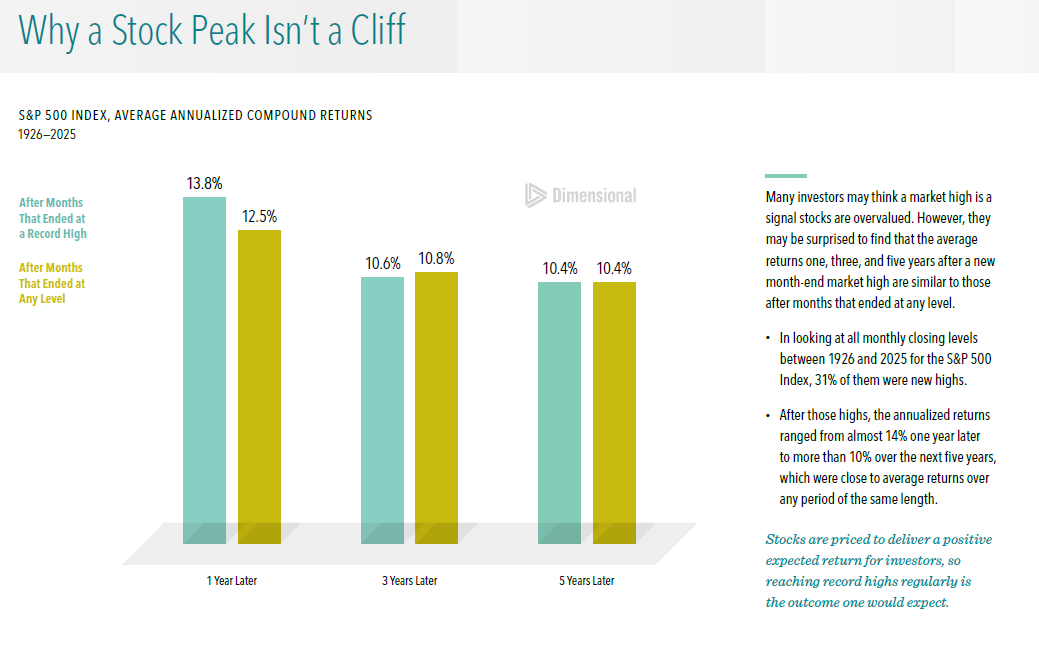
As this illustration shows, average returns following all-time highs have historically looked remarkably similar to returns following the market at any other level. In fact, from 1926 through 2025, nearly one-third of all months ended with the S&P 500 closing at a new record high. This reminds us that an all-time high isn’t necessarily the warning sign some read it to be.
When you think about it, new highs are something we should expect to see. If we expect businesses, and ultimately the markets they make up, to grow in value over time, reaching new highs is part of that process.
That doesn’t mean stocks will continue higher tomorrow, next month, or even next year. Returns are lumpy. Strong periods can be followed by weak ones, bad times can give way to better ones, and trends can last much longer than we expect. The market’s long-term average annualized return of approximately 10% rarely looks “average” in any individual year.
Research suggests that it’s impossible to predict which of those market periods comes next, so successful investing is less about finding the perfect entry point and more about staying invested over time.
Therefore, we focus our efforts on developing a plan that our clients can implement and stick with, ensuring they invest in a highly diversified portfolio, take an appropriate amount of market risk to meet their goals, and make decisions informed by a long-range financial plan developed together.
So, if you’re holding cash and waiting for the market to come down before investing, let’s chat. We’d love to talk through how that decision fits into your broader financial plan and what makes sense for you.