

A Market Decline Is Coming (Relax)

We’ve been hearing familiar questions more often lately:
“The market has been strong for a long time…aren’t we due for a downturn?”
“Do you think the market is going to go down in 2026?”
“Should we prepare for a market decline?”
The short answer is yes.
The important clarification is that this isn’t a prediction, it’s how markets work.
Market declines aren’t rare events or signs that something is “broken” or “wrong.” They are a normal and recurring part of long-term investing. At some point, to some magnitude, the market will decline. It always does. And because we know this, it shouldn’t come as a surprise, or a reason to panic, when it happens.
Uncertainty Is the Price We Pay for Future Returns
If markets moved steadily upward without interruption, investing would feel easy, and returns would likely be much lower. Stocks have historically rewarded patient investors because they come with uncertainty.
Uncertainty isn’t a flaw in the system, it’s the cost of admission.
Every meaningful long-term return comes bundled with periods of discomfort, doubt, and unsettling headlines. The challenge isn’t avoiding uncertainty, it’s deciding how you’ll respond when it inevitably shows up.
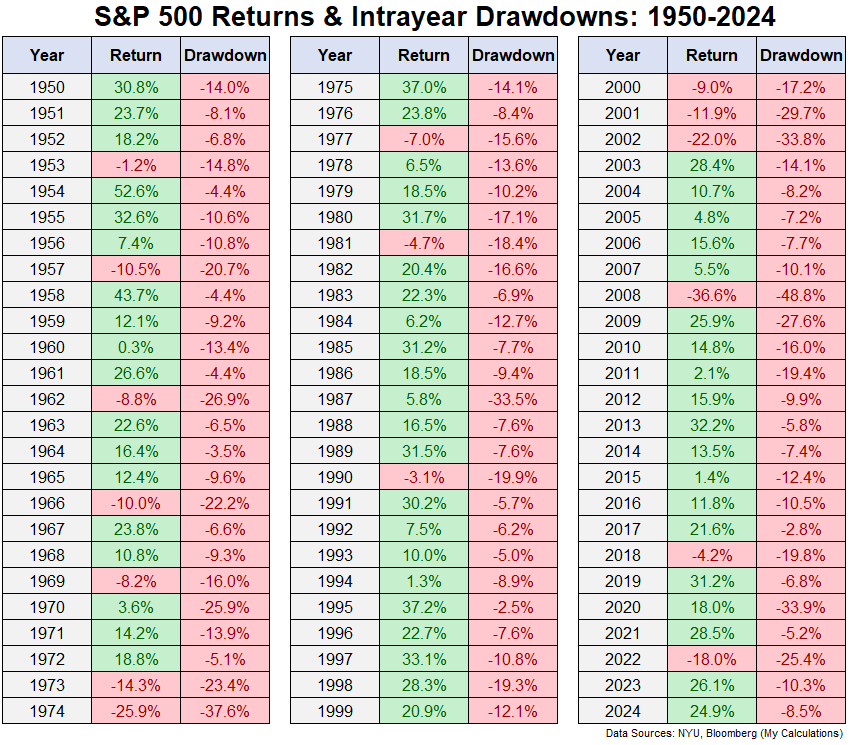
A helpful reminder: markets often experience significant intra-year declines even in positive years. Temporary losses are common, but they don’t hinder long-term growth.
Take a look at the last 75 years of drawdowns of the S&P 500, or the percentage drop from the highest point to the lowest point during a specific year. This shows the temporary losses before potential recovery. For 2025, the drawdown was -18.9% while the S&P500 returned 17.9%.
The Market Has Been Calm. That’s Not a Signal, It’s a Reminder
We’ve experienced an extended stretch without a deep, sustained market decline. That can lull investors into either thinking risk has disappeared, or that the next drop will be somehow “different” or catastrophic.
At Woodward, we like to (verbally) rehearse a “lifeboat drill”. We prefer to run lifeboat drills when the skies are blue and the seas are calm, not when the storm is already here. Preparation is most effective before emotions take over. How will we react to the next “scary” downturn?
Our Role: Helping You Stay in Your Seat
One of the most important parts of our job doesn’t show up in performance charts. It’s helping clients stay in their seat when things get noisy, emotional, or scary. We are your “emotional surge protector”, a buffer between your emotions and your money.
When markets decline, the biggest risk isn’t the downturn itself, but the decisions investors make during it. Acting on fear, chasing headlines, or abandoning a thoughtful plan can do far more damage than volatility alone.
That’s where we come in: providing perspective, reinforcing the purpose behind your portfolio, and keeping the focus on long-term goals instead of short-term noise.
Staying invested through market cycles isn’t accidental. It takes guidance, discipline, and trust.
Why We Emphasize Broad Diversification
At Woodward, we don’t build portfolios around the assumption that any single stock, sector, or strategy will always perform well. History tells us otherwise, and even strong companies can stumble.
Our evidence-based philosophy focuses on broad diversification across asset classes, sectors, and styles. Diversification helps ensure that setbacks in one area don’t derail the entire plan.
Behind the scenes, we’re continuously monitoring portfolios and rebalancing regularly to keep risk aligned with long-term goals. Rebalancing often means doing what feels uncomfortable, trimming what’s gone up and adding to what’s lagged, but over time, it enhances returns.
Staying Invested Is an Active Choice
Our focus isn’t on predicting the next downturn. It’s on building portfolios designed to withstand them, doing the ongoing work to keep plans on track, and helping clients stay confident and invested when markets test that resolve.
When the next bout of volatility arrives, whether in 2026 or some other year, our approach at Woodward won’t change. We’ll be right here, helping you stay in your seat.
Sources:
S&P 500 Returns and Intrayear Drawdowns: 1950-2024 Image: https://awealthofcommonsense.com/2025/11/how-much-will-the-stock-market-fall-in-2026/